Resources
Reflective article
The Quiet Power of Emotion in Moments of Tragedy
Key message
Emotion does not undermine professionalism; it deepens it.
It makes care safer, trauma lighter, and grief less isolating.
When professionals allow themselves to be human, they can help others survive the worst moments of their lives.
Despite its importance, the role of authentic emotion in easing trauma and helping families process devastating news is often overlooked.
Healthcare professionals are taught to stay composed and “professional” when delivering life-altering information, from breaking bad news to informing families a loved one has died. Yet research shows that being emotionally attuned, rather than emotionally absent, makes a remarkable difference in how people experience tragedy.
What the research tells us
Qualitative studies on families who received sudden-death notifications from police found that, months later, survivors reported lower distress and fewer symptoms of complicated grief when the notifier showed gentle, authentic emotion (De Leo et al., 2020–2023). Families described officers who spoke softly, allowed tears to well in their eyes, or showed visible humility as:
- more compassionate
- more trustworthy
- more “human”
- and ultimately, less traumatic to receive news from
In contrast, notifications delivered in a strictly “professional,” detached manner were often remembered as cold, shocking, or even harmful. This echoes earlier policing literature, which notes that while culture expects officers not to cry, recipients often find warmth and shared emotion less brutal (Kirschman, Kamena & Fay, 2014).
Why emotion helps
Humans naturally regulate emotion together. In moments of crisis, people need witnessing, connection, and a sense that the person speaking to them has a heart. Authentic emotion is not sympathy or emotional over-identification, it is compassion in action.
Families who receive vague, detached, or impersonal information reported feeling isolated, overwhelmed, or abandoned. Those who experience even small signs of attuned emotion reported feeling more supported, dignified, and less alone.
Implications for healthcare
Healthcare professionals often stand at the centre of life’s most painful moments. They must navigate:
- sudden tragedy
- families in acute distress
- unpredictable emotional reactions
- death and dying
- their own internal emotional responses
The evidence offers powerful guidance:
1. Emotion humanises the moment.
Families remember how it felt more than what was said. A clinician who shows humanity helps families feel held rather than managed.
2. Emotion models grief safely.
A clinician with tears in their eyes doesn’t burden the family — they signal that the loss matters, the patient mattered, and grief is natural.
3. Emotion forms a protective bond.
Co-regulating with a compassionate professional reduces traumatic shock.
4. Emotion supports ethical care.
Healthcare is not just technical work; it is moral work. Compassion is a clinical skill, not an optional extra.
What “professional” emotion looks like
Showing emotion in tragedy has boundaries. It is not crying uncontrollably or shifting emotional labour onto families. The research indicates that helpful emotional expression tends to be:
- a softening of tone
- a quiet pause to breathe with the family
- allowing eyes to fill without hiding them
- gentle, honest language
- acknowledging the weight of the moment
These gestures communicate:
I am here with you. This is painful. Your grief is seen.
ReferenceDe Leo, D., Shankar, R., Kumpfer, K., & Fang, F. (2022). Communicating unexpected and violent death: The experiences of police officers and health care professionals. OMEGA—Journal of Death and Dying.De Leo, D., Shankar, R., Kumpfer, K., & Fang, F. (2022). Receiving notification of unexpected and violent death: A qualitative study. Death Studies, 46(10), 2522–2532.Hofmann, R., Ehlers, A., & Wild, J. (2023). The impact of police behavior during death notifications on post-traumatic stress and prolonged grief in bereaved individuals. Death Studies, 47(1), 15–26.Kirschman, E., Kamena, M., & Fay, J. (2014). Counseling cops: What clinicians need to know. Guilford Press.
Posts
If you’ve ever gone home heavy, replayed a situation, or felt yourself hardening to cope, you’re not alone.
Research shows gentle, authentic emotion from healthcare professionals can reduce trauma, soften shock, and help families cope.
- A softened voice.
- Tears in your eyes.
- A moment of shared humanity.
These small things make the unbearable just a little more bearable.
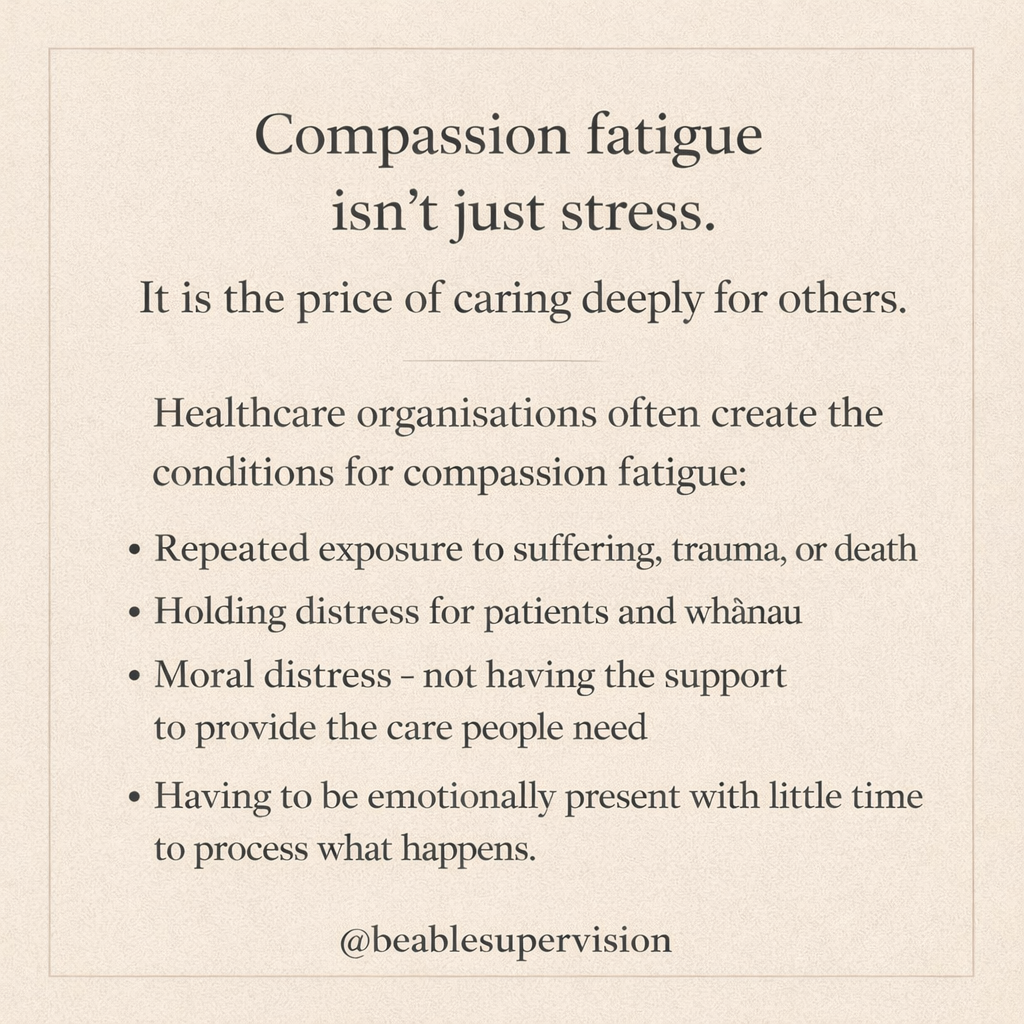
Doctors and nurses witness trauma, absorb distress, and carry the emotional and ethical weight of every shift.
Social workers, psychologists and counsellors all require professional supervision as part of safe practice.
So why not the people caring for patients in their most vulnerable moments?